The Palawan Strand
$115
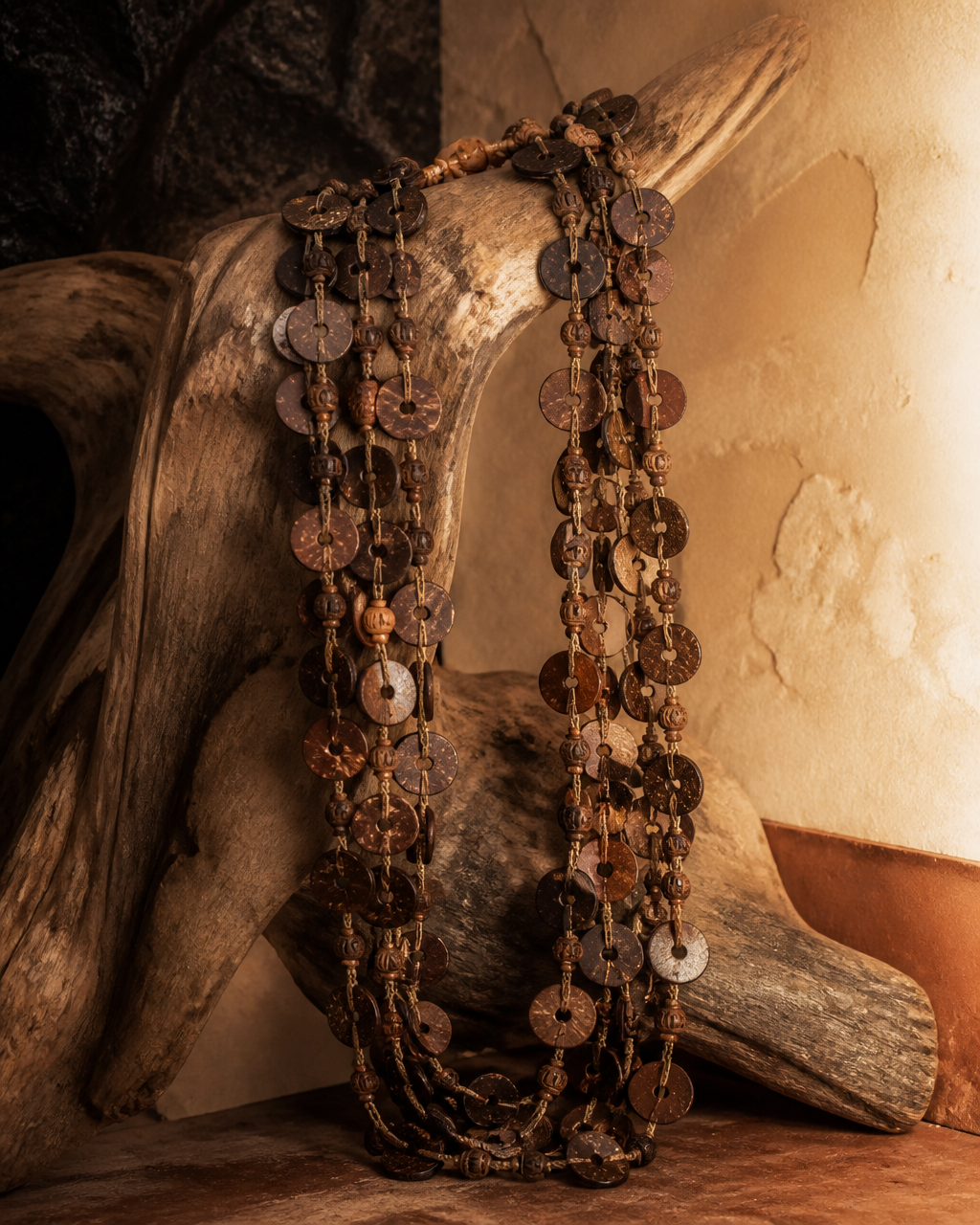
Long layered necklace of small round coconut shell discs and hand-carved wooden beads on natural abaca fiber cord.
Materials
Coconut shell discs, natural abaca fiber cord, hand-carved wooden beads
We are currently sourcing similar pieces from this artisan community. Be the first to know.
Why Liz Chose It
“Maricel makes beauty from what the coconut harvest leaves behind, never taking from a living tree. It's the whole philosophy of this company strung on a single cord.”
— Elizabeth Groch, Founder
The Story of This Piece
The Palawan Strand celebrates the Philippines' extraordinary biodiversity and the resourcefulness of island communities that have learned to create beauty from what the land and sea provide. Palawan — often called the Philippines' last frontier — is an island of pristine forests, limestone cliffs, and crystal-clear waters, and its people have a deep relationship with natural materials.
The coconut shell discs in this necklace are cut and polished by hand from shells that would otherwise be discarded — the byproduct of the coconut industry that sustains many Palawan families. Each disc is sanded smooth and polished to reveal the shell's natural grain, which creates a subtle pattern of brown, black, and amber.
The hand-carved wooden beads are made from fallen branches of native trees — never from living trees — and each bead is carved with simple geometric patterns using hand tools. The abaca fiber cord is made from the stalks of the abaca plant, a relative of the banana that produces one of the strongest natural fibers in the world.
The Artisan
Maricel Santos
Age 28 · Palawan Island, Philippines
Maricel Santos grew up in a fishing village on Palawan's western coast, where life revolves around the rhythms of the sea. Her father was a fisherman; her mother made and sold coconut oil. From an early age, Maricel was fascinated by the coconut shells that accumulated in her family's yard — their smooth interiors, their varied colors, their potential.
She began making simple jewelry as a teenager, selling beaded necklaces to tourists who visited Palawan's famous underground river. Over time, her work became more sophisticated, incorporating carved wooden beads and the abaca fiber that is abundant on the island. She developed a distinctive aesthetic — organic, layered, and evocative of the island's landscape.
At 28, Maricel employs four women from her village and is training others. She is also an active marine conservationist, participating in coral reef monitoring programs and advocating against destructive fishing practices. She donates a percentage of her earnings to a local organization that protects Palawan's endangered species, including the Philippine cockatoo and the Palawan bearcat.