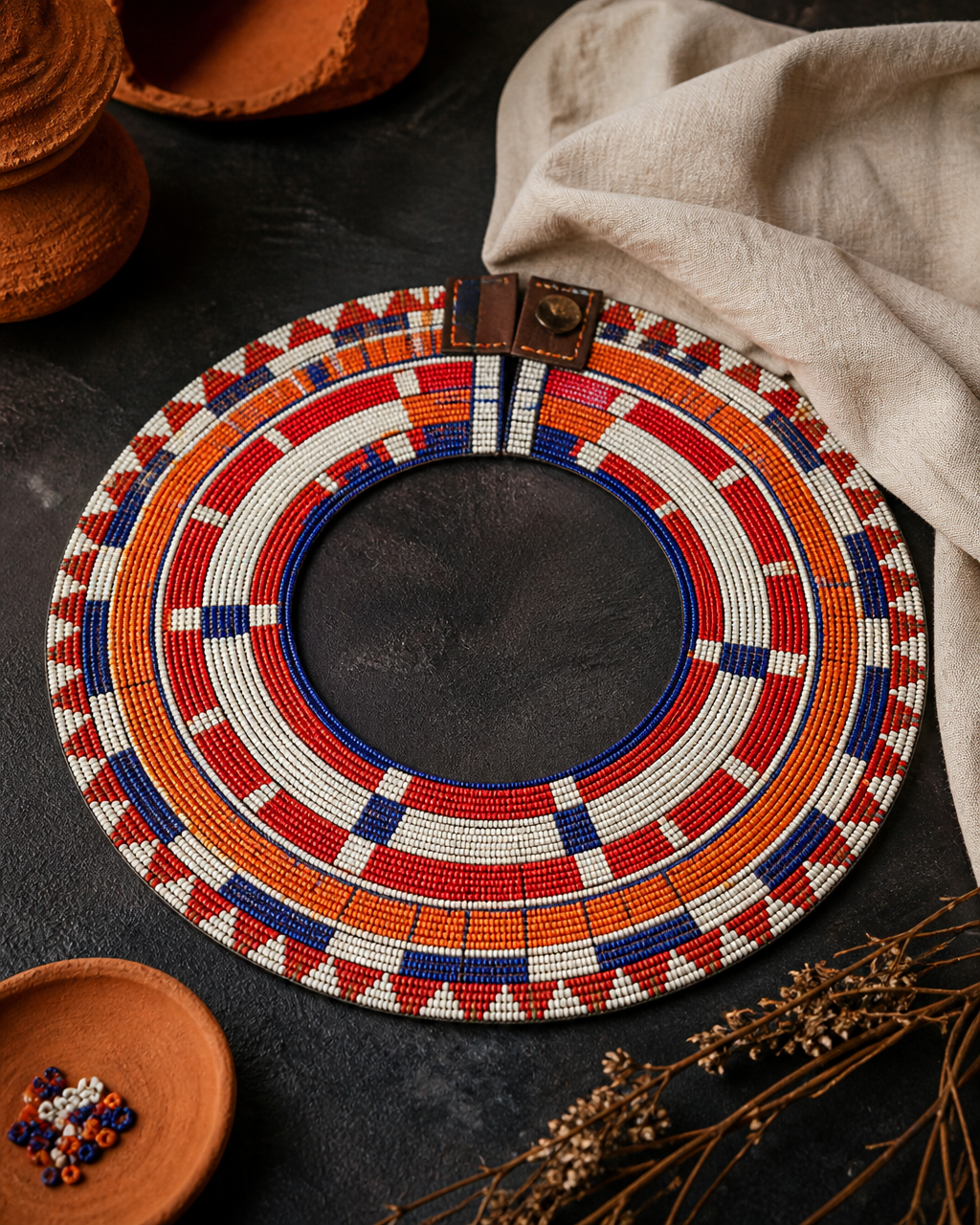
The Maasai Collar
$195
Dramatic flat circular collar necklace of tiny glass seed beads in traditional Maasai colors — red, white, blue, orange — on a stiff wire frame with leather backing.
Materials
Tiny glass seed beads (red, white, blue, orange), stiff wire frame, leather backing
We are currently sourcing similar pieces from this artisan community. Be the first to know.
Why Liz Chose It
“Three thousand beads, placed by feel alone — Naserian's symmetry is a kind of magic. This is the boldest thing in the collection, and the one that makes me stand up straighter.”
— Elizabeth Groch, Founder
The Story of This Piece
The Maasai Collar is arguably the most visually striking piece in the entire collection — a dramatic circle of color that sits flat against the chest like a wearable painting. Maasai beadwork is one of the most recognized art forms in Africa, but its complexity and cultural significance are often underappreciated by the outside world.
Each bead in this collar is placed individually — there are over three thousand beads in a single piece, arranged in concentric circles that follow traditional Maasai color symbolism. Red represents bravery and strength; white represents peace and purity; blue represents the sky and water; orange represents hospitality and warmth.
The collar is constructed on a wire frame that holds its shape while remaining flexible enough to be comfortable. The leather backing — made from locally sourced, naturally tanned hide — protects the skin and adds a layer of warmth and texture.
The Artisan
Naserian Oloisolo
Age 36 · Kajiado County, Maasai Mara region, Kenya
Naserian Oloisolo is a Maasai beadwork artist from Kajiado County in southern Kenya. In Maasai culture, beadwork is exclusively a women's art — one of the few creative domains that belongs entirely to women in a traditionally patriarchal society. Naserian began beading at age eight, taught by her mother and aunts in the traditional way.
By her twenties, Naserian had developed a reputation for exceptional precision and creativity. Her collars are distinguished by their perfect symmetry — a feat achieved without rulers, templates, or any measuring tools, relying entirely on an innate sense of proportion that she describes as 'feeling the pattern.'
Naserian leads a beading cooperative of fifteen women in her community, many of whom are widows or single mothers. The cooperative has transformed the economic landscape of her village, providing steady income where there was previously none. She is also a vocal advocate for girls' education in Maasai communities, using her success as proof that investment in women's skills pays dividends for entire communities.